
Last updated November 15, 2026
 AC repair
 Furnace & heating
 Heat pumps
 Ductless mini splits
 Carrier
 Trane
 Goodman
Seasonal tune-up and full diagnostic on your Carrier, Trane, or Goodman system - readings shown to you before any repair is proposed
Diagnosis first, numbers second - you approve the repair price before a single part goes in.
Get your free estimateDIY vs Professional HVAC: The Sugar Land Homeowner’s Decision Guide
Most homeowners think the DIY-versus-professional question is about money. It’s not. In Sugar Land, the sharper line is legal exposure. Replacing a weak run capacitor on your own condenser is legal, sensible, and cheap. Adding refrigerant to the same system is a federal violation of the Clean Air Act, and the EPA can fine a homeowner thousands of dollars per day for doing it. The gap between “go ahead” and “stop right there” sits in places most people never check. This guide draws that boundary clearly: what you can legally do yourself, what will void a manufacturer warranty, which tools earn their place in your garage, and when a professional visit actually saves you money instead of costing it.
Quick Answer
In Sugar Land, a homeowner can legally replace filters, clean the outdoor coil, clear a drain line, and swap simple electrical parts like capacitors and contactors. Tasks that touch refrigerant, the sealed refrigerant circuit, gas piping, or the high-voltage disconnect are regulated by federal and state rules and belong to licensed professionals. DIY is worth it for filter-level and simple-part work; professional service is worth it for anything involving refrigerant, combustion, or high-voltage diagnosis, because getting it wrong costs more than the repair you were trying to avoid.
Styles & brands we work with
- AC repair
- Furnace & heating
- Heat pumps
- Ductless mini splits
- Carrier
- Trane
- Goodman
Table of Contents
- Where Texas Law Draws the DIY Line
- What You Can Legally Do Yourself in Sugar Land
- Legal but Inadvisable: The Sugar Land Heat Problem
- How DIY Repairs Interact With Your Manufacturer Warranty
- Tools Worth Owning vs. Tools for the Pros
- When Calling a Tech Saves Money on Simple Repairs
- Getting Real Value Out of a Service Visit
- Why Brand-Agnostic Service Changes the Math
Where Texas Law Draws the DIY Line
Texas does not have a single “HVAC license law” the way some states do. Instead, the boundary is set by a stack of rules that overlap, and the one that matters most for homeowners is federal. Under Section 608 of the Clean Air Act, refrigerant handling is restricted to certified technicians. That includes adding refrigerant, recovering it, and any work that opens the sealed circuit. A homeowner who buys a can of R-410A or R-454B and tops off a system is committing a federal violation, and the EPA has been explicit that enforcement applies to individuals, not just contractors. Fines can run into the tens of thousands of dollars per day.
The rest of the boundary is drawn by local permitting and Texas licensing rules on gas and electrical work. Here’s how it breaks down by task type:
- Refrigerant work (charging, recovery, leak repair): Federal, technician-only. Not negotiable, no homeowner exception.
- Gas line work on a furnace: Licensed plumber or HVAC technician required. Gas leaks are the number one reason homeowners get hurt doing HVAC work.
- High-voltage electrical (disconnect box, breaker, compressor circuit): Requires an electrician or HVAC technician with the right license. The disconnect box holds lethal voltage even with the thermostat off.
- Equipment replacement (condenser, air handler, furnace): Requires a permit in most Texas jurisdictions and a licensed installer for warranty and code purposes.
- Low-voltage and simple component swaps (capacitor, contactor, filter, thermostat, coil cleaning): Generally legal for a homeowner. The 24-volt side of an HVAC system is not dangerous the way the 240-volt side is.
If you’re unsure which bucket a repair falls into, the safe default is to call. A quick phone conversation costs nothing. A misjudged DIY job near the disconnect box or the gas valve can cost a lot. Our Delmar AC Repair team fields these questions constantly, and we’d rather talk you out of a dangerous repair than fix the aftermath.
What You Can Legally Do Yourself in Sugar Land
The list of homeowner-legal HVAC tasks is longer than most people expect. Sugar Land homes deal with the same filter-loading and coil-fouling issues any Gulf Coast house does, and most of that is squarely in homeowner territory. Here’s the definitive list of what you can do yourself without breaking a law or voiding a warranty:
- Replace the air filter. Every one to three months in Sugar Land’s heavy-usage months. This is the single highest-value DIY task on the list.
- Clean the outdoor condenser coil. Rinse it with a garden hose, coil cleaner if it’s greasy, and a soft brush. Never use a pressure washer; it bends the fins.
- Clear the condensate drain line. A wet/dry vacuum on the outdoor drain stub clears most clogs. Pour a cup of vinegar down the indoor trap monthly during cooling season to keep algae from forming.
- Straighten bent condenser fins. A fin comb costs a few dollars and restores airflow. Bent fins are the most common cause of poor cooling that isn’t a refrigerant problem.
- Swap a run capacitor or contactor. Both are low-cost parts on the low-voltage side. Turn off the disconnect, discharge the capacitor with an insulated screwdriver, photograph the wiring, and replace like-for-like.
- Replace a thermostat. A smart or programmable thermostat is a straightforward swap if you follow the terminal labels. Photograph before you disconnect; wire colors don’t always match the manual.
- Seal visible duct joints with mastic or foil tape. The joints you can safely reach, at least. The attic section below explains why this becomes a judgment call fast.
- Clear vegetation around the condenser. Two feet of clearance on all sides. Sugar Land shrubs grow fast in the warm, humid months.
All of these are safe, cheap, and legitimate. None require a license. None void a warranty when done correctly. If you want to see how far the official rules go on refrigerant, the EPA’s Section 608 fact sheet is worth ten minutes of reading, and if you’d rather just ask someone, we’re happy to talk it through.
Legal but Inadvisable: The Sugar Land Heat Problem
Here’s the part most DIY guides skip. A lot of work in a Sugar Land attic is technically legal and still a genuinely bad idea. The attic of a typical Sugar Land home in July and August runs hot enough to be a heat-illness hazard within minutes. Attic temperatures in the region regularly climb well past 130°F, and a poorly ventilated attic can be much hotter. That’s not fear-mongering, that’s the reason duct work in this climate is a different job than duct work in a mild climate.
Duct sealing in a 140°F attic
Sealing accessible duct joints is legal for a homeowner. Doing it in a Sugar Land attic in summer is a heat-stroke risk. If you’re going to attempt it, do it in the coolest part of the morning, hydrate aggressively, take breaks every fifteen minutes, and have someone check on you. Or better, hire it out. Duct leakage is one of the top energy losses in a Sugar Land home, and a professional has the tools (a manometer, a duct blaster, sometimes a thermal camera) to find and fix leaks you’d never see by eye.
Electrical work near the high-voltage disconnect
The high-voltage disconnect box that feeds your condenser holds 240 volts. It’s lethal even with the thermostat “off” and the indoor breaker tripped, because the disconnect sits between the breaker and the equipment. Replacing a contactor inside the unit is legal for a homeowner in many cases, but you’re working inches from that disconnect. If you’re not certain where the panel-side power stops, don’t open the cabinet. The cost of an electrician’s visit is nothing compared to the cost of a mistake here.
Anything that requires climbing onto a hot roof
Cleaning the condenser is a ground-level task. Reaching roof-mounted equipment, working around a package unit on a low-slope roof, or chasing a leak in attic insulation is not. Sugar Land summers make roof work genuinely dangerous. If the job requires getting on the roof, it’s a professional call.
Honest rule of thumb: if the work is ground-level, low-voltage, and reachable in a shaded area, DIY is fair game. Anything involving height, heat, or 240-volt exposure gets a professional.
How DIY Repairs Interact With Your Manufacturer Warranty
The most misunderstood piece of the DIY debate is the manufacturer warranty. The Magnuson-Moss Warranty Act, a federal law, says a manufacturer cannot void your warranty just because you serviced the equipment yourself. That protection is real. But it has limits most homeowners don’t know about, and the limits look different across brands.
What generally does NOT void a warranty
- Replacing the filter yourself. Maintenance tasks that the owner’s manual describes as owner maintenance are always protected.
- Cleaning the outdoor coil. Routine cleaning is homeowner maintenance.
- Swapping a thermostat with a compatible model. Keep the receipt and the old part, but this is legal.
- Using a non-dealer service company. A Carrier, Trane, Lennox, or American Standard system does not require dealer-only service. Any licensed HVAC contractor can service it without affecting the warranty.
What CAN void coverage, depending on the manufacturer
- Refrigerant added by an uncertified person. Most brand warranties require refrigerant work to be done by a certified technician. If a homeowner adds refrigerant and the compressor later fails, the manufacturer can point to the uncertified work as grounds to deny the compressor claim.
- Failure caused by a mismatched part. Capacitors, contactors, motors, and compressors have specifications. Installing an undersized capacitor or a motor with the wrong horsepower can void the part and anything downstream.
- Installation without a permit. Replacement equipment installed without the required permit can lose the parts-and-labor warranty because the manufacturer’s terms typically assume code-compliant installation.
- Undocumented modifications. Any modification not approved by the manufacturer (bypassing a safety switch, rewiring a control board) is grounds for denial in almost every brand’s terms.
The practical takeaway is simple. Do the owner’s-manual maintenance yourself. Call a licensed technician for anything that touches refrigerant, gas, or a matched component. And when you do call, use someone who works on your brand without being tied to a dealer agreement. A Carrier system serviced by a Carrier-only dealer and an American Standard system serviced by an American Standard-only dealer are both fine, but neither is necessary. Our team works across nine major brands, so we’re not going to steer you toward the equipment our supply agreement favors.
Tools Worth Owning vs. Tools for the Pros
The tool question is where a lot of homeowners accidentally overspend or under-diagnose. A great multimeter is worth its price. A cheap manifold gauge set almost never is. Here’s the honest breakdown of what to own, what to skip, and what each tool actually tells you.
Tools worth owning
- Digital multimeter (autoranging, with capacitance and microamp settings). Tells you whether a capacitor is within spec (most run capacitors are rated in microfarads, and a meter with a capacitance function can test that in seconds), whether a contactor is pulling in, and whether you have 24 volts at the thermostat terminals. This is the single most useful tool in the homeowner kit. Spending $80 to $150 on a decent one is worth it.
- Non-contact infrared thermometer. Tells you the temperature split between the supply and return air at the vents. A healthy system cools the return air by roughly 15 to 20 degrees. If the split is low, you know there’s a problem (charge, airflow, duct leak); if it’s high, you know airflow is restricted. It won’t tell you which of those it is, but it tells you whether to call.
- Digital manometer. Measures static pressure in the return and supply plenums. Tells you whether the system is starved for airflow. This is the tool most homeowners don’t think to own, and it’s the one that saves the most money in detective work. A basic digital manometer runs $40 to $100.
- Fin comb, soft brush, coil cleaner, wet/dry vacuum. The cleaning kit. Cheap and genuinely useful.
- Fin straightener for condenser coils, plus a garden hose sprayer. Gets fins back to full airflow without damaging them.
Tools only professionals should buy
- Manifold gauges, refrigerant scale, recovery machine, vacuum pump. These are the tools for the sealed refrigerant circuit. Owning them does not make the work legal for a homeowner.
- Refrigerant leak detector (heated diode or infrared). These run $300 to $800, and interpreting the result requires knowing what leaks normally look like. Not worth owning.
- Combustion analyzer for furnaces. A carbon-monoxide safety tool every professional should carry, and a tool that makes no sense for a homeowner to own.
- Duct blaster and thermal camera. The equipment that finds duct leaks and insulation gaps. The thermal camera alone costs $300 or more; the diagnostic value comes from interpretation, not the hardware.
If you own the first three items on the “worth owning” list, you can diagnose more of your system than most homeowners can. If a diagnosis stalls, that’s when a professional call actually pays for itself. Our technicians carry the full set of pro tools, and getting the diagnosis right the first time is what keeps the invoice honest.
When Calling a Tech Saves Money on Simple Repairs
The instinct on a “simple” repair is to handle it yourself. Sometimes that works. Sometimes it turns a $200 repair into a $1,200 one because the wrong part gets replaced three times. The math is straightforward once you see it laid out.
Take a system that isn’t cooling well. Three possible causes: low refrigerant, a failing capacitor, or a duct leak. A homeowner without a multimeter will guess. Maybe the capacitor “looks bad.” Swap it, still not cooling. Maybe it’s the thermostat. Swap that, still not cooling. By the time the actual cause (low refrigerant, say) is identified, three parts have been swapped and the original problem is still there. The homeowner spent $80 on a compressor capacitor that wasn’t the problem and two or three hours of their time.
A professional visit costs a diagnostic fee. In exchange, you get:
- A measured diagnosis. Superheat and subcool, static pressure, temperature split, amp draw. The technician measures and rules causes in or out.
- The right part the first time. A good tech knows which components typically fail on your brand and which ones rarely do.
- A written record. You’ll know what was found, what was fixed, and what to watch for next season. That record matters for warranty claims.
- No upsell pressure if the diagnosis is clear. A capacitor swap is a five-minute job once it’s identified. A good shop charges for the diagnosis and the part, and stops there.
Simple repairs where a professional visit usually pays for itself:
- System runs but doesn’t cool. Too many possible causes; trial-and-error parts swapping gets expensive fast.
- System short-cycles. Could be a low-pressure switch tripping (refrigerant), a high-pressure switch tripping (dirty coil or failing fan), or a control board. Each fix is different.
- Furnace won’t light. Gas, ignition, flame sensor, pressure switch. Most homeowners can’t safely sort these out. This is squarely in furnace repair territory.
- Ice on the indoor coil. Could be low refrigerant, a bad blower motor, or a clogged filter. The wrong guess in either direction costs money, and refrigerant work is professional-only.
- Any repair where the DIY attempt has already failed once. The second attempt is almost always more expensive than a call.
Getting Real Value Out of a Service Visit
A service visit is more valuable when you prepare for it. The technician has a limited window and a house full of components to check. Homeowners who know what to ask get more out of the visit, and they spend less because the technician can narrow down faster. Here’s how to get real information out of a professional call:
- Write down what you observed and when. “Not cooling well” is vague. “Not cooling well since the thermostat started showing 78 with a setpoint of 72, and the outdoor unit runs constantly” gets a technician to the answer faster.
- Have the model and serial numbers ready. On the outdoor condenser (side panel label) and the indoor air handler or furnace (usually inside the blower compartment). Writes down both before the visit.
- State your DIY history honestly. If you swapped a capacitor last summer, say so. If you added refrigerant from a can, say so. The technician needs to know what’s already been done, and hiding it makes the diagnosis slower and the warranty picture murkier.
- Ask for the measurements, not just the verdict. “What was the superheat reading?” “What was the static pressure?” “What’s the temperature split?” A technician who’s diagnosing correctly can tell you the readings and what they mean. A technician who can’t gets moved down your list.
- Ask what the fix will and won’t cover. If the diagnosis is “low refrigerant,” ask what the leak source is, what the repair costs, and whether the fix is likely to hold through the Sugar Land cooling season. Don’t accept “we’ll charge it up” as a repair.
- Ask about the rest of the system. A furnace service call in winter is a good time to ask about the AC’s condition, and vice versa. One visit, two systems evaluated, no second dispatch fee.
If you don’t have a technician you trust yet, that’s the piece worth solving first. A Sugar Land service visit from our team starts with a written diagnosis, a clear scope, and no surprises on the invoice. If the fix is a capacitor, we say so and stop.
Why Brand-Agnostic Service Changes the Math
One of the reasons the DIY-versus-professional question feels harder than it needs to be is that many homeowners have been told, directly or subtly, that their brand “requires” a dealer. It doesn’t. Manufacturers set warranty terms that any licensed contractor can meet on most repairs, and the equipment itself doesn’t know who’s working on it. A Carrier condenser, a Trane air handler, a Lennox furnace, and an American Standard heat pump all follow the same basic physics and use the same class of components.
What that means in practice: you don’t need a dealer to preserve your warranty, and you don’t need to accept the dealer’s recommendation on replacement equipment just because the visit started with them. A brand-agnostic contractor can quote multiple manufacturers and recommend based on the home, the budget, and the efficiency target, not on a supply agreement.
When you’re ready for AC installation or a full-system evaluation, the brand-agnostic model also means the same team handles heating and cooling without a handoff. That’s the model we work under at Delmar AC Repair. Nine major brands, both sides of the system, and recommendations that don’t start with a single manufacturer’s logo. Our technicians have up to 15 years of experience across that range.
Common Mistakes to Avoid
- Adding refrigerant from a store-bought can. It’s a federal violation under Section 608, it can void your compressor warranty, and it does nothing to fix the leak that caused the low charge. Don’t do it.
- Swapping parts without testing them. A capacitor that looks fine can be 15% below its rated microfarads and still be the problem. A capacitor that looks bulged can still test fine. Test before you replace, or don’t replace.
- Attempting duct sealing in an attic during summer. Sugar Land attic heat is a genuine safety issue. If the ducts you need to reach are in a 130°F-plus attic, the job belongs to someone with a schedule, water, and a spotter.
- Replacing a thermostat with a model that doesn’t match your system type. Heat pumps and two-stage systems need specific thermostat compatibility. A mismatched swap can leave you with a system that won’t run at all.
- Ignoring the filter for six months. In Sugar Land, filter loading is heavy. A clogged filter causes frozen coils, high head pressure, and premature blower failure. The cheapest HVAC tool you own is a calendar reminder.
- Assuming a dealer is required for warranty service. It isn’t in most cases. Using a non-dealer doesn’t void the warranty; unlicensed refrigerant work might.
- Trying to fix one problem and accidentally creating another. A homeowner who swaps a contactor but wires it wrong can fry the control board on the next call for cool. Photograph and label before you disconnect.
See the difference
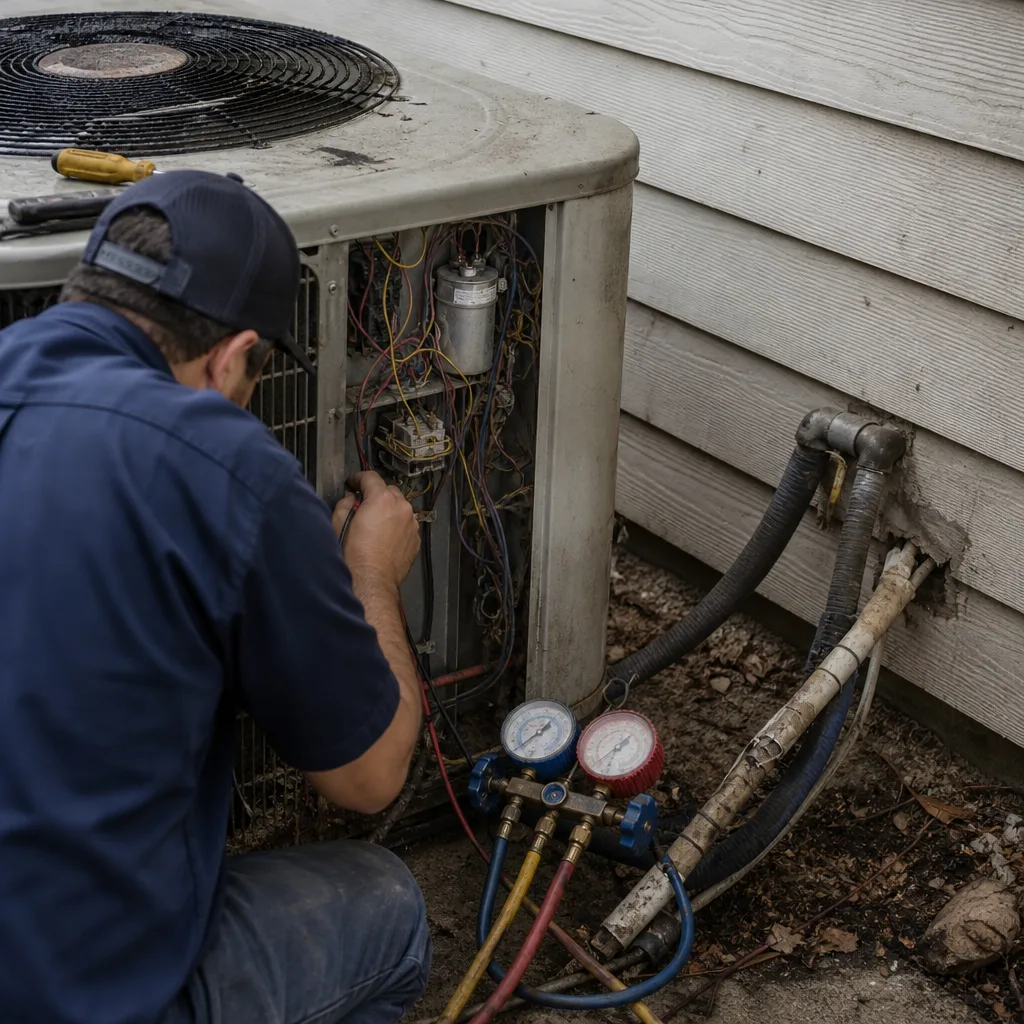 Before
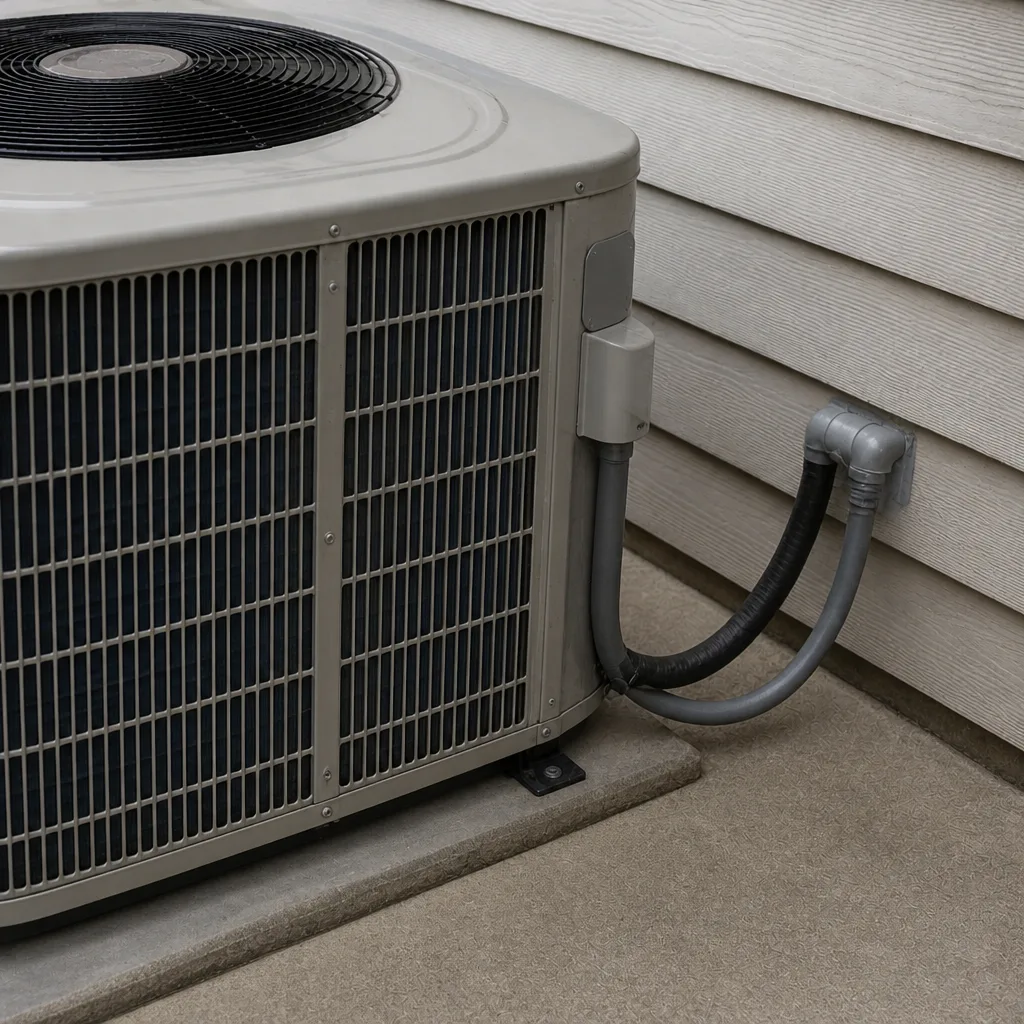 After
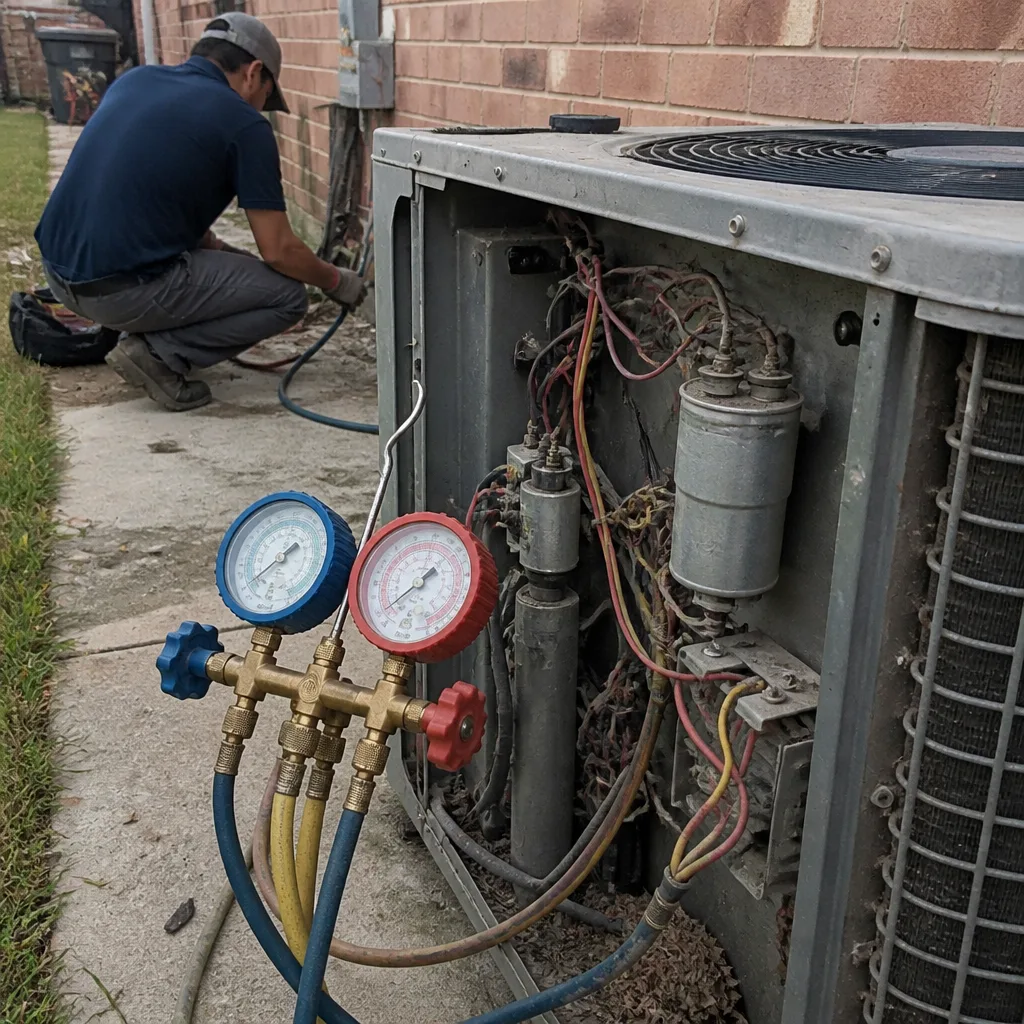 Before
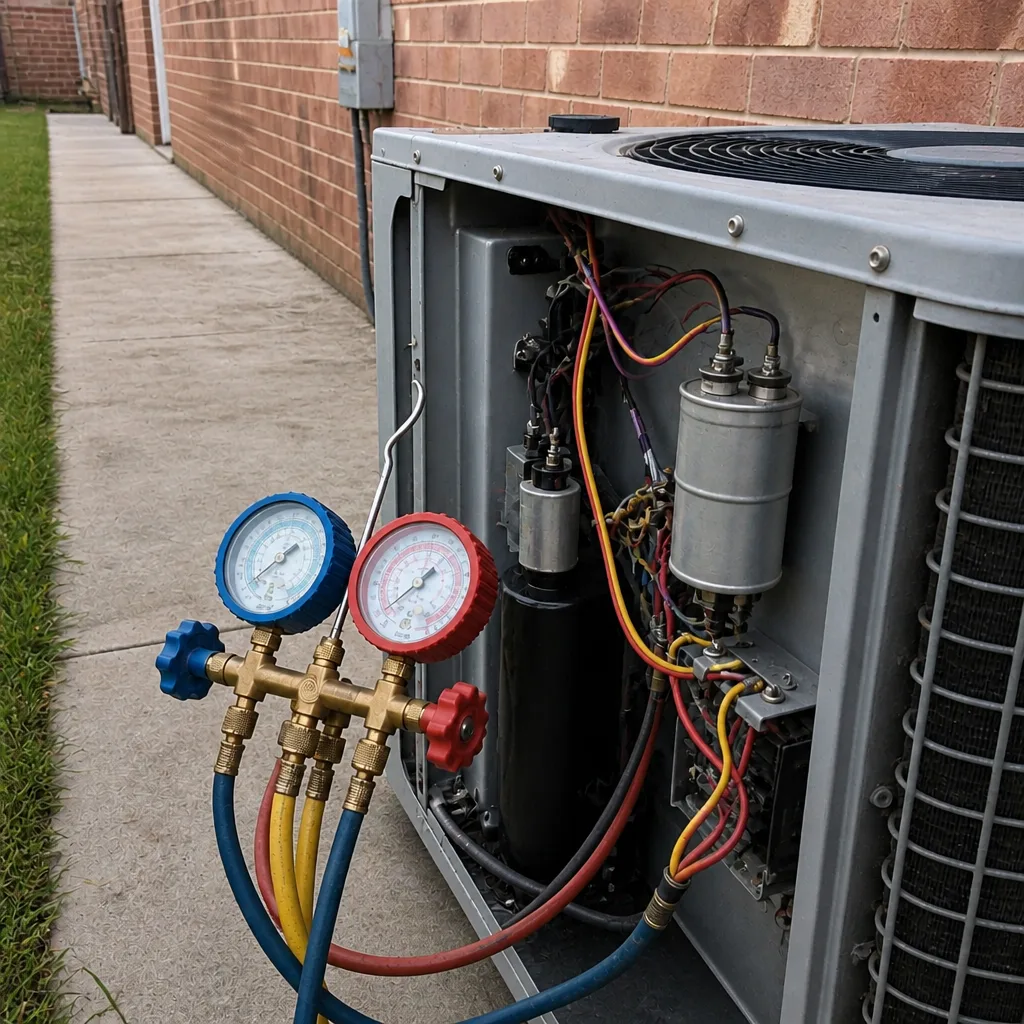 After
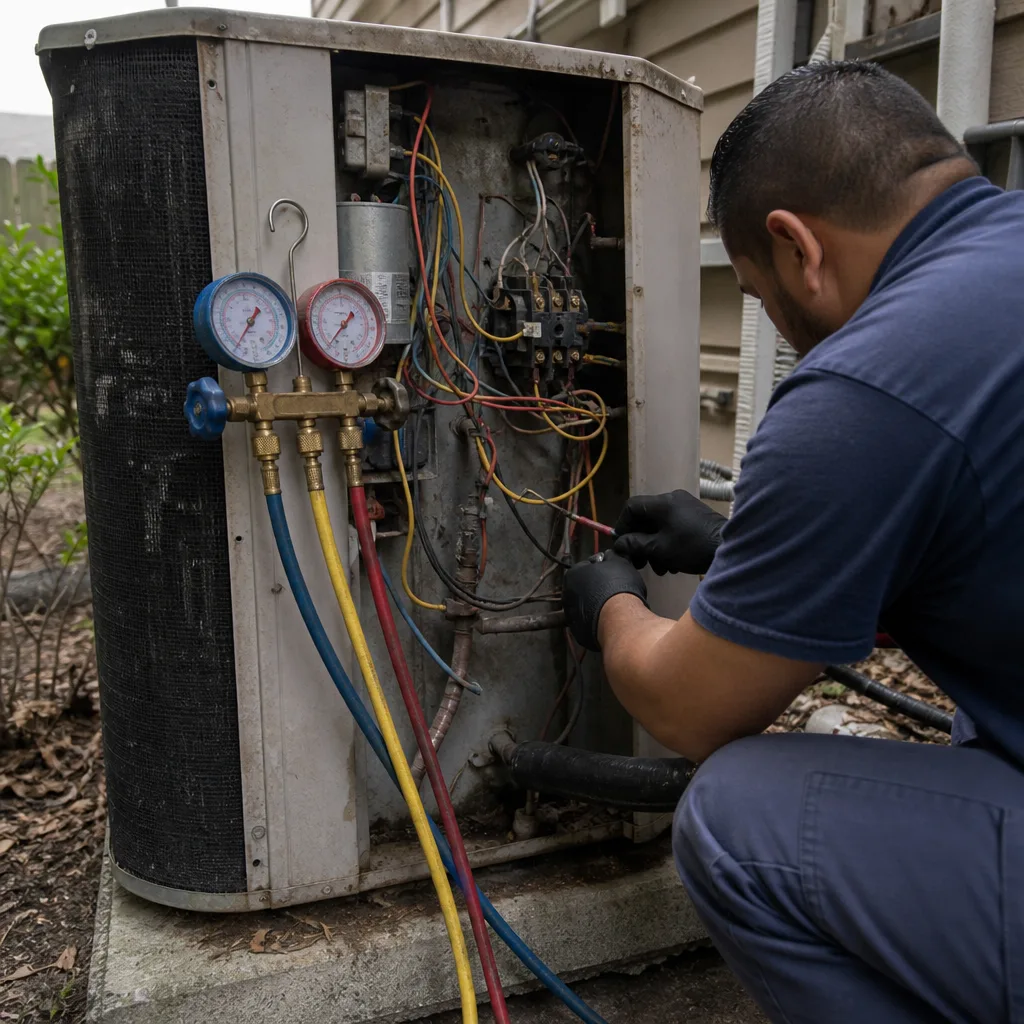 Before
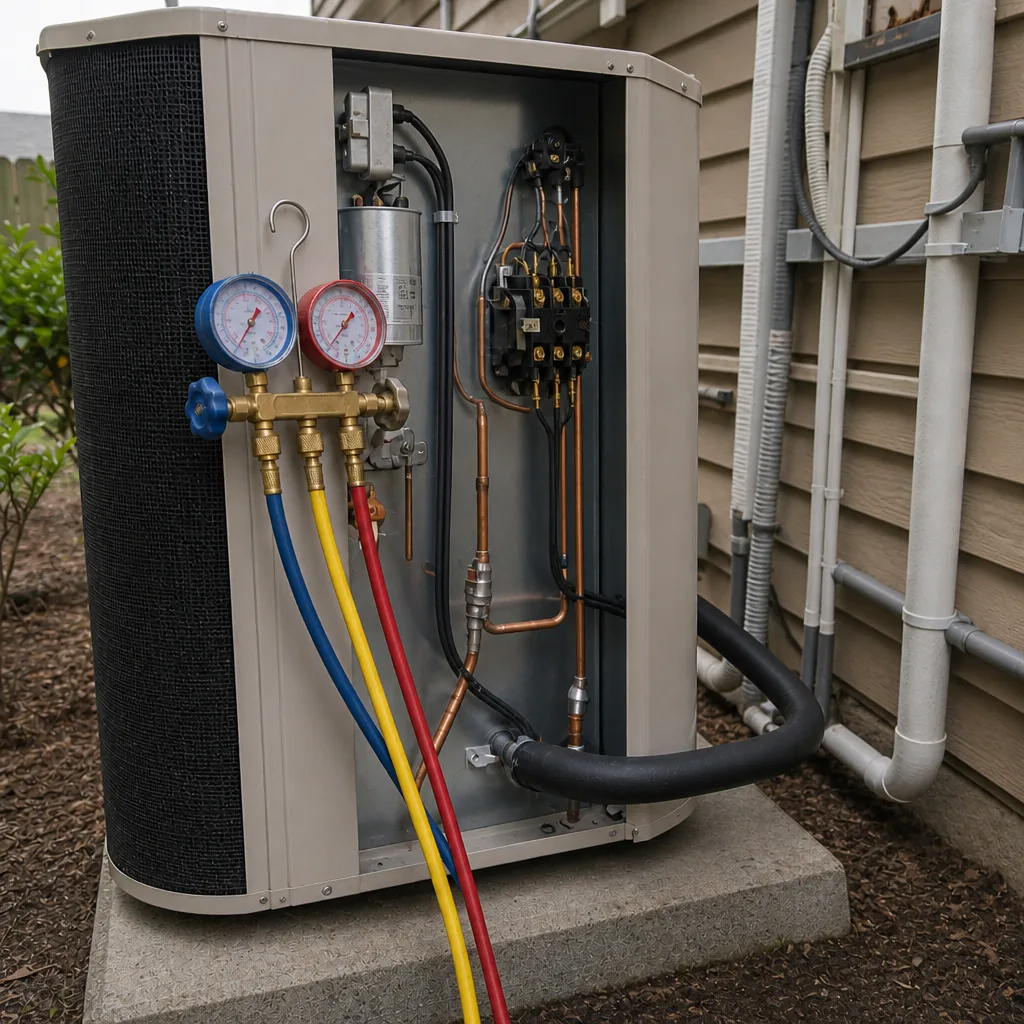 After
When to Call a Professional
Call a professional any time the repair touches refrigerant, gas, the high-voltage disconnect, or the sealed circuit. Also call when the diagnosis has already failed once, when the repair requires climbing into a hot attic or onto a roof, and when the system is brand-new enough that a warranty claim is likely. The line isn’t about how complicated the job looks; it’s about whether a mistake can cause a federal violation, a legitimate safety hazard, or a warranty denial. Any of those three is worth a phone call. If you want a written scope before you decide, Delmar AC Repair offers free estimates in Sugar Land. Call (833) 968-5064. We answer 24/7. Fast dispatch from 7am to 7pm, Sunday through Friday.
Frequently Asked Questions
No. Adding refrigerant to a residential AC system is a federal violation of the Clean Air Act unless you’re a Section 608-certified technician, and the EPA can fine individuals for doing it. The refrigerant circuit is also the most common place a homeowner causes permanent damage (overcharge, moisture introduction, compressor damage), so even setting aside the law, it’s the wrong job to attempt.
No. The Magnuson-Moss Warranty Act protects routine homeowner maintenance like filter changes, coil cleaning, and thermostat swaps. What can void a warranty is unlicensed refrigerant work, installing a mismatched part, or modifying the system in a way the manufacturer didn’t approve. Keep your receipts and document what you did.
Yes, if you have a multimeter with a capacitance setting and you turn off the disconnect first. A run capacitor is a low-voltage-side component, it’s cheap, and it’s one of the most common failures in Sugar Land’s long cooling season. Discharge it before touching the terminals and photograph the wiring before you disconnect.
Charging the system. Homeowners read that “low refrigerant means low cooling,” buy a can, top it off, and end up with an overcharged system, a compressor running at high head pressure, and a warranty problem. The actual fix is finding and stopping the leak, which is a professional job. Replacing a capacitor with the wrong microfarad rating is the second most common mistake.
Often, yes. Same-day appointments are common for diagnostic visits, and if the fix is a straightforward component swap, it can usually be done on the first visit. For a repair that requires a special-order part, the technician will book the follow-up before leaving. Call (833) 968-5064 for the next opening.
No. Trane’s warranty terms, like those of Carrier, Lennox, American Standard, and other major brands, require licensed service but do not require a dealer of that specific brand. Any licensed HVAC contractor who meets the manufacturer’s parts and installation requirements can service the system without affecting coverage.
The Bottom Line
The DIY-versus-professional line in Sugar Land is drawn by federal refrigerant law, Texas licensing rules, and manufacturer warranty terms, not by how hard the job looks. Do the filter changes, the coil cleanings, the thermostat swaps, and the simple low-voltage component replacements. Skip the refrigerant work, the gas piping, the high-voltage disconnect, and anything that puts you in a 130°F attic in July. Own the three tools that earn their place (multimeter, infrared thermometer, manometer) and skip the rest. When a diagnosis stalls or the repair crosses a legal line, call a licensed technician who works on your brand without a dealer agenda. Our team is here to diagnose it correctly the first time and give you a written scope before any work begins.
Call Delmar AC Repair at (833) 968-5064 for a free estimate. We answer 24/7. Fast dispatch from 7am to 7pm, Sunday through Friday. We work on your brand, we cover heating and cooling, and we recommend the system that fits your home, not the one that fits a supply agreement.
Written by the team at Delmar AC Repair.